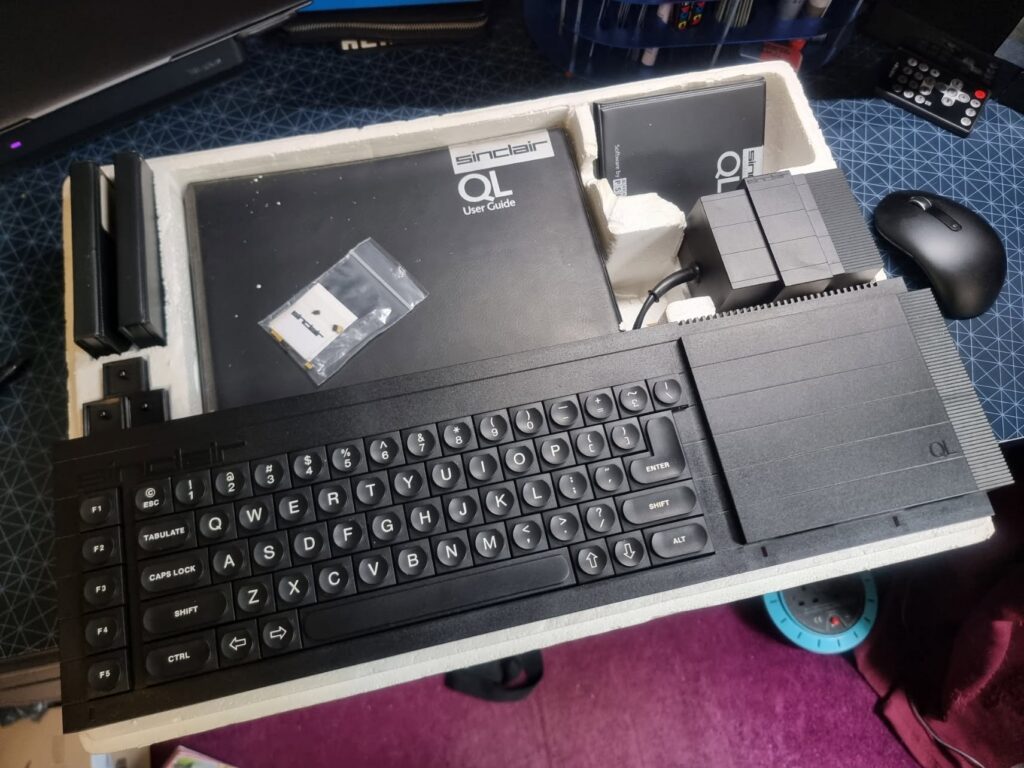
Every so often, a piece of vintage tech comes along that feels less like a purchase and more like a rescue mission. That’s exactly how it feels now that I’m the proud owner of a Sinclair QL, acquired for an absolute song. For a machine that once represented Sir Clive Sinclair’s bold leap into the world of “professional” computing, finding one in restorable condition feels like uncovering a small but significant slice of 1980s ambition.
A Brief History of the QL
Launched in 1984, the Sinclair QL (short for Quantum Leap) was intended to be Sinclair’s answer to the growing demand for business‑oriented home computers. It arrived with a Motorola 68008 CPU, multitasking QDOS, built‑in Microdrives, and a sleek, futuristic design. Unfortunately, it also arrived late, buggy, and saddled with the famously temperamental Microdrive system. Despite its flaws, the QL developed a loyal following and remains one of the more fascinating machines from the era—an ambitious, quirky outlier that dared to be different.
Today, surviving QLs are often found with tired membranes, dead Microdrives, or boards showing the scars of time. Which is why this one feels like such a gem.
First Impressions: A Surprisingly Healthy Machine
The machine boots, which is already a promising start. The keyboard membrane, however, has reached the end of its natural life—no surprise for a QL—so a replacement has been ordered and is now on its way. Once that’s fitted, I’ll be able to give the machine a proper shakedown.
What’s genuinely encouraging is the condition of the internals. The motherboard is spotless, free from corrosion, dust, or the usual signs of aging that often plague machines of this vintage. Even more impressive are the Microdrives, which look remarkably clean. The cartridges themselves are in excellent shape too; the felts are still springy and intact, which is half the battle with these notoriously delicate storage units.
The Plan Ahead
Once the new membrane arrives and the keyboard is responsive again, I’ll begin a full service:
- Power‑on tests with proper keyboard input
- Microdrive spin‑up and read/write checks
- Cartridge testing (starting with the best‑condition one)
- Internal inspection for any lurking capacitor or connector issues
- External clean and polish to bring back that classic QL aesthetic
If all goes well, this QL could become a fully functional part of my retro computing lineup—a machine that not only boots, but works exactly as Sinclair intended (or at least as close as the QL ever got).
Why This Matters
Restoring a QL isn’t just about reviving a computer; it’s about preserving a moment in computing history when innovation was messy, daring, and wonderfully eccentric. The QL was Sinclair’s attempt to leap ahead of the competition, and even though it stumbled, it remains a fascinating reminder of a time when the future of computing was still being invented on kitchen tables and in small British workshops.
And now, one of those machines is on my bench, ready for a second life.