There are moments in retro‑computing where you feel like a triumphant engineer… and moments where you feel like the village idiot. This story contains both, in rapid succession.
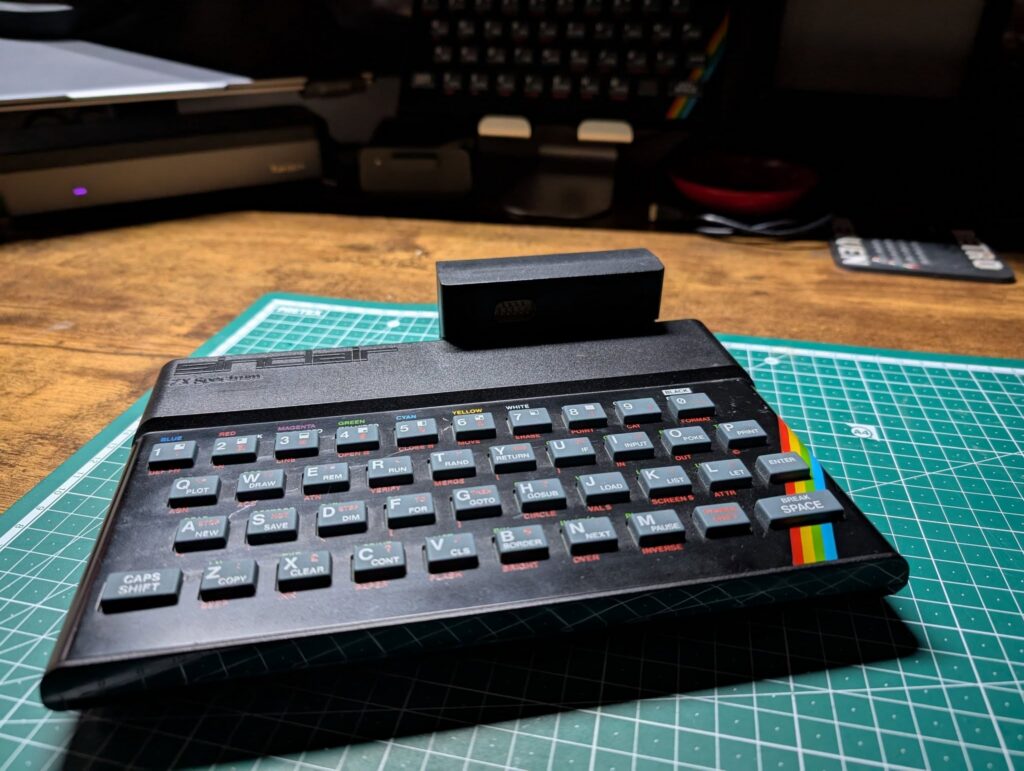
Last week I was refurbing a ZX Spectrum for my own use — a nice, straightforward job. Clean the board, replace the capacitors, and finish off a composite mod so I could finally retire the RF fuzz. Everything was going perfectly. The machine looked great. The composite mod was neat. I was ready for that satisfying first power‑on.
And then I put 24V through it at the wrong polarity.
The Moment of Electronic Self‑Destruction
If you’ve never watched a capacitor violate itself right in front of you, it’s… educational. There’s a split second where your brain goes, “That’s not right,” followed immediately by a puff, a pop, and the unmistakable smell of regret.
The Speccy died instantly. No flicker, no partial boot. I knew I’d created a small disaster.
Tonight’s Resurrection Attempt
After letting the shame settle for a few days, I sat down tonight determined to repair the damage. The casualty list was… extensive.
| Component | Status | Notes |
|---|---|---|
| Voltage Regulator | Dead | Took the full brunt of the reversed polarity |
| Transistors at TR4, TR5, TR7 | Blown | All replaced |
| Diode at D1 | Toasted | Replaced |
| Capacitors | Various trauma | Probably didn’t have to, but a full recap performed |
| Composite Mod | No picture | Investigated separately |
| RAM | Miraculously fine | Still don’t understand how |
With everything replaced, cleaned, and triple‑checked, I powered it up — cautiously, like approaching a cat you accidentally sprayed with water.
To my absolute shock, the memory survived. How any of the 48K of RAM didn’t blow under that abuse is a mystery. These little machines may be forty plus years old, but they are tougher than they look!
To test the Spectrum, I loaded up Computer Scrabble, and it ran perfectly. No crashes, no corruption, no weird artefacts. The Speccy was alive again.
The Composite Mod Mystery
When I first powered up the Spectrum, I was using a ZX‑HD — ByteDelight’s excellent interface that adds true HDMI output to any unmodified ZX Spectrum. The picture came through perfectly, exactly as expected… however, things weren’t quite so rosy on the composite side.
The composite mod was still completely dead. No signal, no flicker, nothing. Considering the 24V mishap, I had a strong suspicion that TR1 or TR2 might have been collateral damage. So I dove back into the video circuitry, tracing signals, checking voltages, and quietly questioning some of Sinclair’s more “creative” design decisions.
Eventually, I tracked the fault down to the real culprit: A 22µF capacitor at C25, right in the middle of the video circuit. It hadn’t actually failed electrically — it simply wasn’t soldered properly and was making a poor connection. That tiny intermittent joint was enough to kill the composite output entirely.
Once I resoldered and replaced it, the composite signal came straight back to life — clean, stable, and exactly as it should be.
Victory (and Lessons Learned)
So the Speccy is fully restored — recapped, repaired, resurrected, and now producing a clean composite picture. It’s hard to believe that after feeding it 24V backwards, the machine still had the decency to survive.
And the lesson? Even when you think you’ve completely annihilated a vintage machine, there’s usually a way back — as long as you’re willing to dig, diagnose, and replace the occasional capacitor that decided to take early retirement.