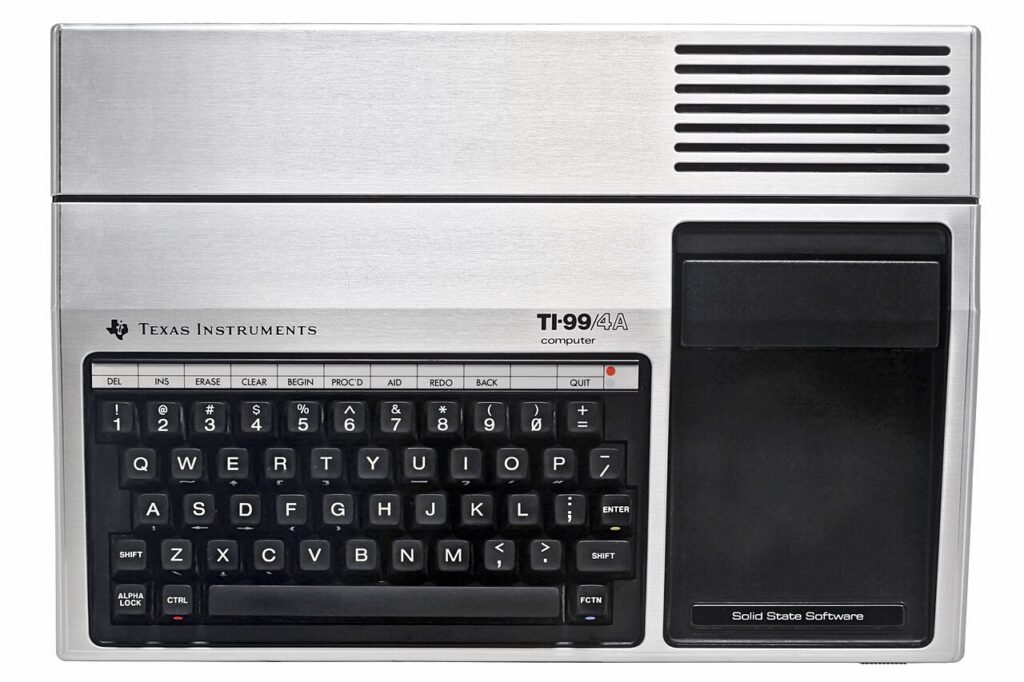
People at work know I have a soft spot for vintage machines, so every now and then a piece of computing history finds its way to me. This time, a colleague donated not one but two classics: a TI‑99/4A and a Compaq Portable from the early 1980s. Today’s post focuses on the TI‑99/4A itself—its background, its significance, and why it still matters. I’ll cover the restoration journey in a separate article.
A Computer Ahead of Its Time
When people think of Texas Instruments, calculators are usually the first products that come to mind. Yet in the early 1980s, TI made a serious attempt to become a major player in the rapidly growing home computer market. The result was the TI-99/4A, a machine that combined innovative technology, ambitious engineering, and aggressive pricing, earning it a unique place in computing history.
The TI-99/4A was launched in the United States in May 1981 as the successor to the less successful TI-99/4. One of its biggest selling points was its processor: the TMS9900, a 16-bit CPU running at 3 MHz. At a time when many home computers still relied on 8-bit processors, the TI-99 series became one of the first commercially available 16-bit home computer platforms.
The new model improved on its predecessor by replacing the criticised calculator-style keyboard with a full-travel keyboard and introducing the enhanced TMS9918A graphics chip. These changes made the machine significantly more appealing to home users and hobbyists.
Specifications and Features
The TI-99/4A shipped with 16 KB of RAM, built-in TI BASIC, colour graphics, sound capabilities, and support for software distributed on ROM cartridges. Users could also connect cassette drives, floppy disk systems, printers, serial interfaces, memory expansions, and a range of other peripherals.
One particularly interesting accessory was the optional Speech Synthesizer, reflecting Texas Instruments’ expertise in speech technology from products such as the Speak & Spell. This allowed certain applications and games to produce spoken words and phrases, a feature that felt remarkably futuristic in the early 1980s.
For more serious users, Texas Instruments offered the Peripheral Expansion Box (PEB), an external chassis that could house expansion cards for additional memory, floppy disk controllers, serial ports, and other hardware. The expansion system gave the machine capabilities that extended far beyond typical home computing tasks.
The Performance Problem
Despite its impressive specifications, the TI-99/4A had a significant architectural limitation. Although it used a 16-bit processor, much of the surrounding hardware relied on an 8-bit data path. Access to memory and peripherals often required data to pass through a 16-to-8-bit multiplexer, creating a bottleneck that reduced the real-world performance advantages of the CPU.
As a result, the machine did not always outperform competing systems despite its technically superior processor. The TI-99/4A became a classic example of how overall system design can matter just as much as headline specifications.
Success Through Price Cuts
Initially introduced at $525 (£384 at 1981 exchange rates), the TI-99/4A entered an increasingly competitive market alongside systems such as the Commodore VIC-20, Atari 400/800, and Apple II. Texas Instruments responded to competition with a series of price reductions and consumer rebates.
The strategy worked in the short term. By the end of 1982, the TI-99/4A had become one of the best-selling home computers in America, reportedly controlling around 35% of the market and selling approximately 150,000 units per month.
However, the aggressive price cuts eventually became unsustainable and by 1983, some versions of the machine were being sold for less than $100, often below manufacturing cost. While sales volumes were high, the losses were severe.
The End of the Line
Texas Instruments ultimately decided that the home computer market was no longer a profitable business. The company announced the discontinuation of the TI-99/4A in late 1983, with production ending in March 1984.
Despite its relatively short life, the computer was far from a failure. Estimates suggest that between 2.5 and 2.8 million units were sold worldwide, giving it one of the largest installed bases of any home computer of its era.
Legacy
Today, the TI-99/4A is remembered as an ambitious and influential machine. It brought 16-bit computing into the home, offered advanced graphics and speech capabilities, and demonstrated both the opportunities and risks of competing in the fiercely contested home computer market of the early 1980s.
For modern enthusiasts, the TI-99/4A remains a fascinating snapshot of an era when manufacturers were willing to experiment boldly, sometimes succeeding brilliantly and sometimes learning expensive lessons along the way. Its distinctive silver-and-black design, expandable architecture, and pioneering technology ensure its place as one of the most memorable home computers of the early personal computing revolution.
References
The Centre for Computing History
https://www.computinghistory.org.uk/det/57286/Texas-Instruments-release-the-TI99-4A-in-the-USA/
Wikipaedia
https://en.wikipedia.org/wiki/TI-99/4A
The National Museum of Americal History
https://americanhistory.si.edu/collections/object/nmah_1064832