The Colour Attribute System (8×8 Blocks)
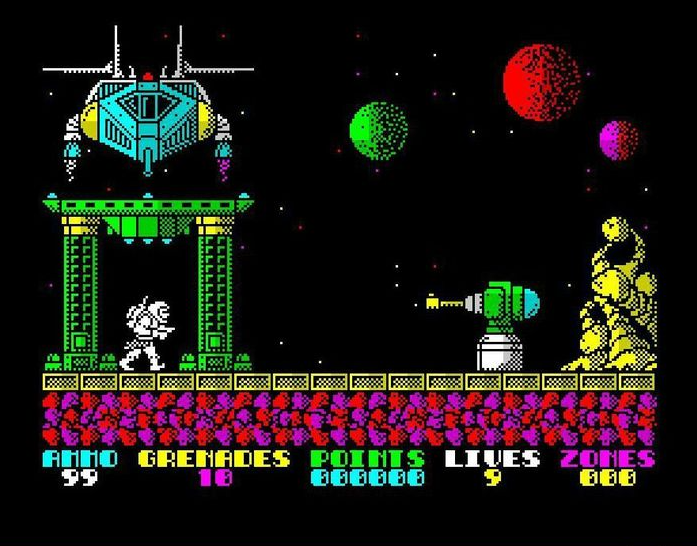
The Spectrum’s display offered a 256×192 resolution, but colour wasn’t stored per pixel; instead, each 8×8 block shared a single foreground colour, background colour, and brightness level. This clever compromise saved a huge amount of memory, yet it also produced the famous “colour clash,” where sprites changed colour as they overlapped and characters flickered when moving across differently coloured backgrounds. Developers quickly learned to design around the limitation, shaping a visual style defined by bold, chunky sprites, carefully planned colour zones, and monochrome characters placed against vibrant backdrops. What could have been a flaw instead became a defining aesthetic — one of the Spectrum’s most recognisable traits.
Cassette Tape Loading & the Iconic Striped Screens
Sinclair kept costs low by relying entirely on cassette tapes for software, avoiding expensive disk drives and embracing a loading system that became one of the Spectrum’s most recognisable traits. Every game began with the machine’s iconic striped loading bars and the piercing screech of data tones, followed by a patient wait of two to five minutes — and sometimes a failed load that meant rewinding the tape and trying again. Yet this humble medium also opened the door to cheap game distribution, home‑grown software, and the thriving culture of type‑in listings from magazines, helping to fuel the bedroom‑coder revolution of the early 1980s. Those colourful loading bars weren’t just a technical necessity; they became part of the Spectrum’s soul.
These Constraints Shaped Every Spectrum Game
Game developers quickly discovered that the ZX Spectrum’s limitations weren’t just technical quirks — they were fundamental constraints that shaped every aspect of how games were designed, coded, and played. With only 48K of RAM (and in many cases just 16K), programmers had to become masters of efficiency, writing almost everything in tight assembly language and squeezing every last byte to make room for graphics, logic, and sound. The machine’s colour‑attribute system forced them to avoid colour clash through careful sprite placement and bold visual design, while memory contention between the CPU and the ULA meant timing tricks were essential to keep games running smoothly. Even the humble beeper demanded creativity, pushing developers to invent clever techniques to produce music and effects from a single channel. Loading games from cassette added another layer of challenge, requiring reliable routines that could survive the quirks of home tape decks.
Yet these constraints didn’t stifle creativity — they ignited it. Out of this environment came some of the most iconic titles of the 8‑bit era: Manic Miner, with its smooth animation and in‑game music; Jetpac, showcasing fast action and crisp visuals; Atic Atac, pushing the boundaries of top‑down adventure design; and Elite, a technical marvel that delivered a vast 3D universe within the Spectrum’s tiny memory footprint. Far from holding developers back, the Spectrum’s limitations encouraged a generation of programmers to innovate, experiment, and ultimately redefine what was possible on a home computer.
Peripherals: The Spectrum’s Expanding Universe
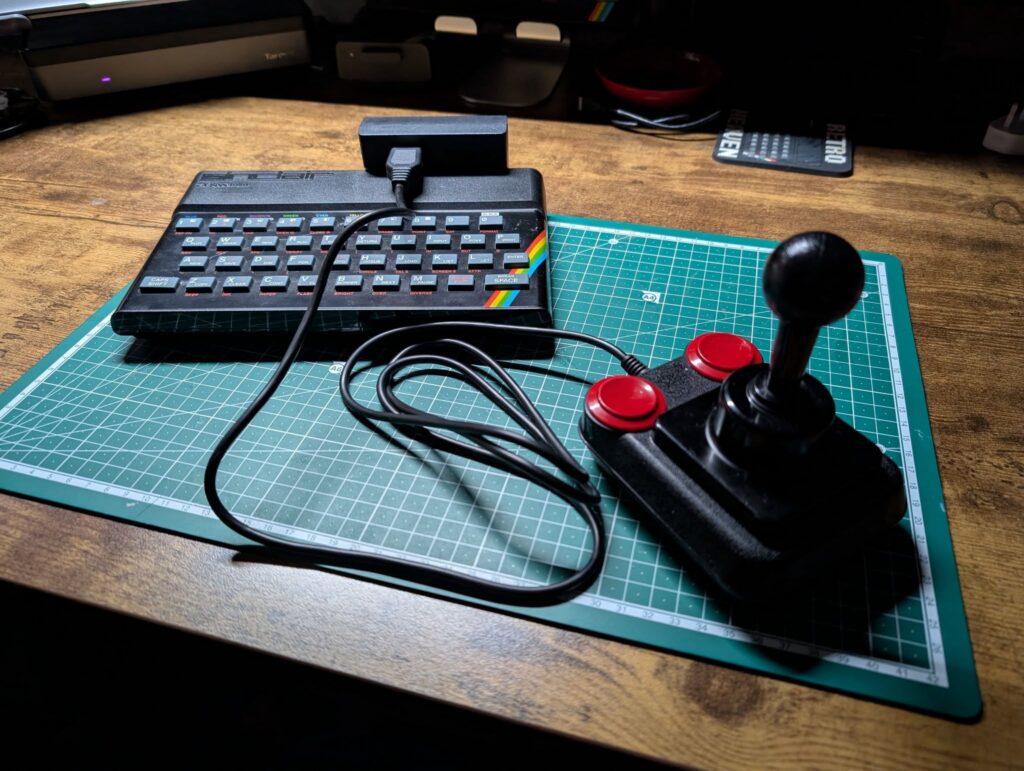
The ZX Spectrum’s open hardware design meant that almost anything could be plugged into its edge connector, and this flexibility sparked a thriving third‑party market of peripherals that expanded the machine far beyond its modest beginnings. One of the most common add‑ons was the joystick interface, since the Spectrum shipped without any built‑in joystick ports. Interfaces from Kempston, AGF, and Protek quickly became essential for gaming, each offering its own standard that developers often supported directly in their titles. Sinclair also produced its own official ZX Printer, a quirky spark‑based device that burned silver text onto black paper — noisy, limited, and undeniably iconic. More experimental accessories appeared too, such as light pens, which detected CRT scanlines to let users “draw” directly on the screen, though their accuracy varied wildly depending on the television.
As the Spectrum’s popularity grew, so did the demand for more comfortable input options, leading to a wave of third‑party keyboards designed to replace the original rubber membrane with full‑travel keys that felt more like a traditional typewriter. Sinclair’s Interface 2 added two joystick ports and a ROM cartridge slot, hinting at a future of instant‑loading games, although only a small library ever took advantage of it. Together, these peripherals created an ecosystem that was as inventive and eccentric as the Spectrum itself, turning a simple home computer into a highly customisable platform that encouraged experimentation and helped define the early days of British computing.
Why the Spectrum Still Matters
The ZX Spectrum wasn’t perfect — far from it. But its flaws were part of its charm. It was affordable, approachable, and endlessly hackable. It empowered a generation of bedroom coders, launched legendary studios, and created games that still inspire developers today.
And for me, it will always be the computer that appeared unexpectedly on a dining table one lunchtime — a gift that shaped my childhood and my love of computing.